
What Is Triethylenediamine (TEDA)? | CAS 280-57-9
Triethylenediamine (TEDA), also known as 1,4-diazabicyclo[2.2.2]octane (DABCO), is a highly efficient tertiary amine catalyst with the CAS number 280-57-9 and molecular formula C₆H₁₂N₂. This organic compound features a unique bicyclic structure with two nitrogen atoms, making it a crucial component in polyurethane foam production, pharmaceuticals, and specialty chemicals.
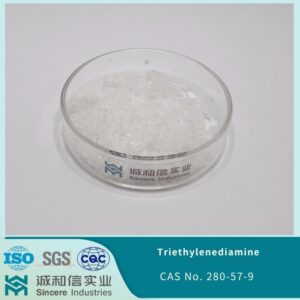
TEDA appears as a white crystalline solid with a melting point of 158–162°C. It is hygroscopic (absorbs moisture) and soluble in water, alcohols, and polar solvents. Due to its high catalytic activity, it accelerates chemical reactions in industrial processes while maintaining stability under heat.
What Is TEDA Used For? Industrial Applications
Polyurethane (PU) Foam Production
TEDA is primarily used as a catalyst in PU foam manufacturing, where it speeds up the reaction between polyols and isocyanates. This results in better foam expansion, curing, and improved product quality for mattresses, insulation, and automotive seats.
Pharmaceutical & Agrochemical Synthesis
In pharmaceuticals, TEDA acts as an intermediate in drug synthesis. It also plays a role in agrochemicals, helping produce pesticides and herbicides.
Coatings & Adhesives
Due to its ability to enhance polymerization, TEDA is used in industrial coatings, sealants, and adhesives, ensuring strong bonding and durability.
Safety & Handling of TEDA
Storage: Keep in a cool, dry place, sealed to prevent moisture absorption.
PPE Required: Use gloves, goggles, and lab coats when handling.
Conclusion – Why Is TEDA Important?
Triethylenediamine (TEDA) is a versatile catalyst critical in PU foam, pharmaceuticals, and coatings. Its unique structure (C₆H₁₂N₂), efficiency, and stability make it indispensable in industrial chemistry.