Trimer acid Redefines Durability in Offshore and Oilfield
Introduction
In the world of heavy industrial engineering, materials are constantly at war with their environments. Marine vessels battle unrelenting saltwater corrosion; heavy-duty industrial machinery endures extreme shear stress under immense heat; and downhole oilfield equipment operates under a destructive cocktail of high pressure, moisture, and corrosive gases.
While traditional additive technologies have pushed performance boundaries for decades, a fundamental secret to next-generation durability lies within the backbone of the base polymers and reactive intermediates themselves. Specifically, it lies within the unique, branched chemistry of Trimerized Fatty Acid (Trimer Acid).
Marine & Heavy-Duty Coatings: Building an Impenetrable Shield
In marine paints, coatings often fail due to micro-cracking. This happens under mechanical stress or UV exposure. Once the polymer matrix cracks, moisture and chloride ions reach the metal substrate.
Standard dimer acids offer decent structure. However, they lack the dense, multi-directional cross-linking needed for harsh offshore environments.
By incorporating C54 Trimer Acid into epoxy curing agents and polyamide resins, formulators unlock two massive advantages:
-
-
The Ultimate Hydrophobic Barrier: The long-chain carbon structure introduces dense hydrophobic segments into the coating matrix. This effectively repels water molecules. It cuts down the moisture vapor transmission rate (MVTR) to near zero.
-
Flexible Toughness: Rigid aromatic cross-linkers make coatings brittle. In contrast, the branched C54 architecture introduces flexibility without sacrificing hardness. This prevents cracking during the physical flexing of ship hulls. It also stops cracking during the thermal expansion of pipelines.
-
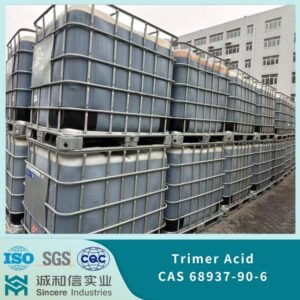
Oilfield Auxiliaries: Corrosion Inhibition at 5,000 Meters Deep
To protect multi-million dollar assets downhole, corrosion inhibitors must form an incredibly tenacious organic film on the metal surface—one that refuses to wash away under high flow rates and boiling subterranean temperatures.
Trimerized Fatty Acid serves as an exceptional base for synthesis in these oilfield auxiliaries. Because of its carboxylic acid functionality spread across a high-molecular-weight branched structure, it creates a multi-anchor chemisorption layer on iron and steel surfaces. The polar heads bind fiercely to the metal. while the massive C54 tail network forms a thick. dense hydrocarbon blanket that completely isolates the metal from acid and moisture attacks.