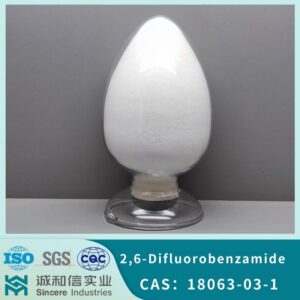
CAS 18063-03-1| 2,6-Difluorobenzamide in Fluorinated Agrochemicals
A Premier Fluorinated Building Block
This compound (CAS 18063-03-1) is prized not as a final active ingredient, but as a versatile synthetic intermediate. Its structure features a benzamide core—a known pharmacophore—precisely functionalized with two fluorine atoms at the 2 and 6 positions. This specific arrangement provides a unique three-dimensional shape and electronic profile that chemists utilize to construct complex molecules with tailored biological properties. It is, in essence, a high-value “molecular Lego brick” for advanced agrochemical discovery.
Enhancing Herbicide Performance
A primary application of 2,6-Difluorobenzamide (CAS 18063-03-1) lies in developing modern herbicide classes, such as certain sulfonylureas and pyrimidinyl ethers. These herbicides achieve ultra-low application rates and high selectivity. Researchers use this intermediate to synthesize key molecular fragments, which subsequently inhibit the enzyme acetolactate synthase (ALS) in target weeds.
Contributing to Advanced Fungicides
Beyond herbicides, this intermediate also supports the synthesis of novel fungicides, especially within the Succinate Dehydrogenase Inhibitor (SDHI) class. SDHI fungicides play a crucial role in controlling a broad spectrum of fungal diseases. Introducing the 2,6-difluorobenzamide moiety enhances systemic mobility and residual activity, ensuring stronger and longer-lasting crop protection throughout the growing season.
A Strategic Asset for R&D and Supply Chains
For agrochemical companies, securing high-purity 2,6-Difluorobenzamide (CAS 18063-03-1) represents a clear strategic advantage. It enables efficient route exploration for both novel patentable molecules and established off-patent active ingredients. As a critical link in the supply chain, consistent quality and reliable supply of such intermediates directly support the production of vital crop protection products, which underpin global agricultural productivity.