From in-cosmetics Global to Market Reality: Why Mushroom Chitosan Is Gaining Strategic Importance
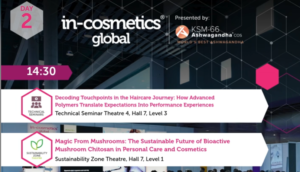
At this year’s in-cosmetics Global in Paris, one signal stood out: mushroom chitosan was clearly positioned within a framework of “functionality + sustainability,” rather than being treated as a mere supplement to traditional chitosan. To understand this shift, it is necessary to revisit the role chitosan itself plays in the personal care industry.
Chitosan: From Basic Raw Material to Functional Ingredient
Chitosan, a natural polysaccharide derived from crustacean shells, has over the past decade evolved from a basic raw material into a functional ingredient. Its antibacterial properties, ability to repair the skin barrier, and role in regulating the skin microbiome have made it a key component in the premium segment targeted by international brands. According to industry estimates, the global chitosan market reached approximately USD 13 billion in 2023, with a compound annual growth rate exceeding 20%. Such growth is uncommon for a relatively mature ingredient system, indicating that its application boundaries are still expanding.
Industrial Validation: From Concept to Commercial Scale
More importantly, chitosan has already been validated by leading companies as a scalable commercial ingredient, rather than a laboratory concept. For example, BASF’s HYDAGEN® HCMF represents an industrialized application of chitosan in hair care. As a cationic film-forming and styling polymer, it not only provides basic hold but also emphasizes repair of damaged hair, particularly in addressing split ends. This is significant—it shows that chitosan has moved from being an auxiliary conditioning agent to a core functional component. Its use across multiple formats such as mousses, sprays, and styling lotions further demonstrates its formulation compatibility and maturity.
Another strong indicator comes from the brand side. L’Oréal has already developed patents related to chitosan, covering applications for skin, lips, and body care. This suggests that chitosan is no longer driven solely by raw material suppliers but has entered the long-term technological pipeline of major brands. Once incorporated into patented systems and formulation strategies, its lifecycle typically spans a decade rather than representing a short-term trend.
Why Mushroom Chitosan Matters Now
Against this backdrop, the significance of mushroom chitosan becomes clearer. It is not an entirely new ingredient, but rather an extension built upon an already validated technological pathway. In other words, the industry no longer needs to prove whether chitosan works—it only needs to determine whether there is a better source. Traditional crustacean-derived chitosan has no major functional shortcomings. However, in the European market, it increasingly faces two practical constraints: labeling and certification challenges associated with animal-derived ingredients, and the communication cost linked to potential allergens. These issues are particularly relevant in the premium segment, where brands must deliver not only performance but also a compelling and consumer-friendly ingredient narrative.
Mushroom chitosan directly addresses this gap. Produced via fermentation or fungal extraction, it retains the molecular structure and functional mechanisms of conventional chitosan while avoiding animal-origin limitations. This enables brands to upgrade their positioning toward “vegan” and “sustainable” claims without compromising performance. This substitution is already emerging in practical applications. In scalp care and sensitive skin products, some European brands are testing fungal-derived polysaccharide systems as alternatives to traditional cationic conditioning agents, aiming to create lighter, less burdensome film-forming structures. In skincare, mushroom chitosan is increasingly positioned as a functional carrier, where controlled molecular weight and degree of deacetylation allow for a balance between film formation and active ingredient synergy. While these applications are not yet fully scaled, they have clearly moved beyond conceptual discussion into real formulation validation.
Scaling Potential: Technology and Cost Convergence
From a supply perspective, cost and consistency have historically limited the commercialization of mushroom chitosan. However, advances in fermentation technology are narrowing this gap. As costs approach acceptable levels, brand willingness to transition is likely to increase. Given the already established market foundation of chitosan, this shift is unlikely to be incremental experimentation; rather, it may occur rapidly within specific product lines. A more realistic conclusion, therefore, is that chitosan itself will not be replaced, but its source structure is evolving. In cost-driven markets, traditional sources will continue to dominate. In contrast, in premium segments where compliance, sustainability, and brand storytelling are critical, mushroom chitosan is emerging as the preferred option.
In response to this trend, we have been advancing the productization of mushroom chitosan, including tailoring molecular weight and degree of deacetylation for different applications, as well as supporting customers with initial formulation testing. Feedback from the market shows that inquiries are shifting from single performance indicators to a more comprehensive evaluation framework encompassing source origin, functional performance, and regulatory alignment, consistent with the signals observed at the exhibition.
The message from in-cosmetics Global is clear: the industry is no longer asking whether chitosan is important, but rather which type of chitosan aligns best with future market logic. Mushroom chitosan is gaining attention precisely because it meets both technological maturity and market-driven expectations at this stage.