BMIM PF6 in Perovskite Solar Cells: Research and Applications
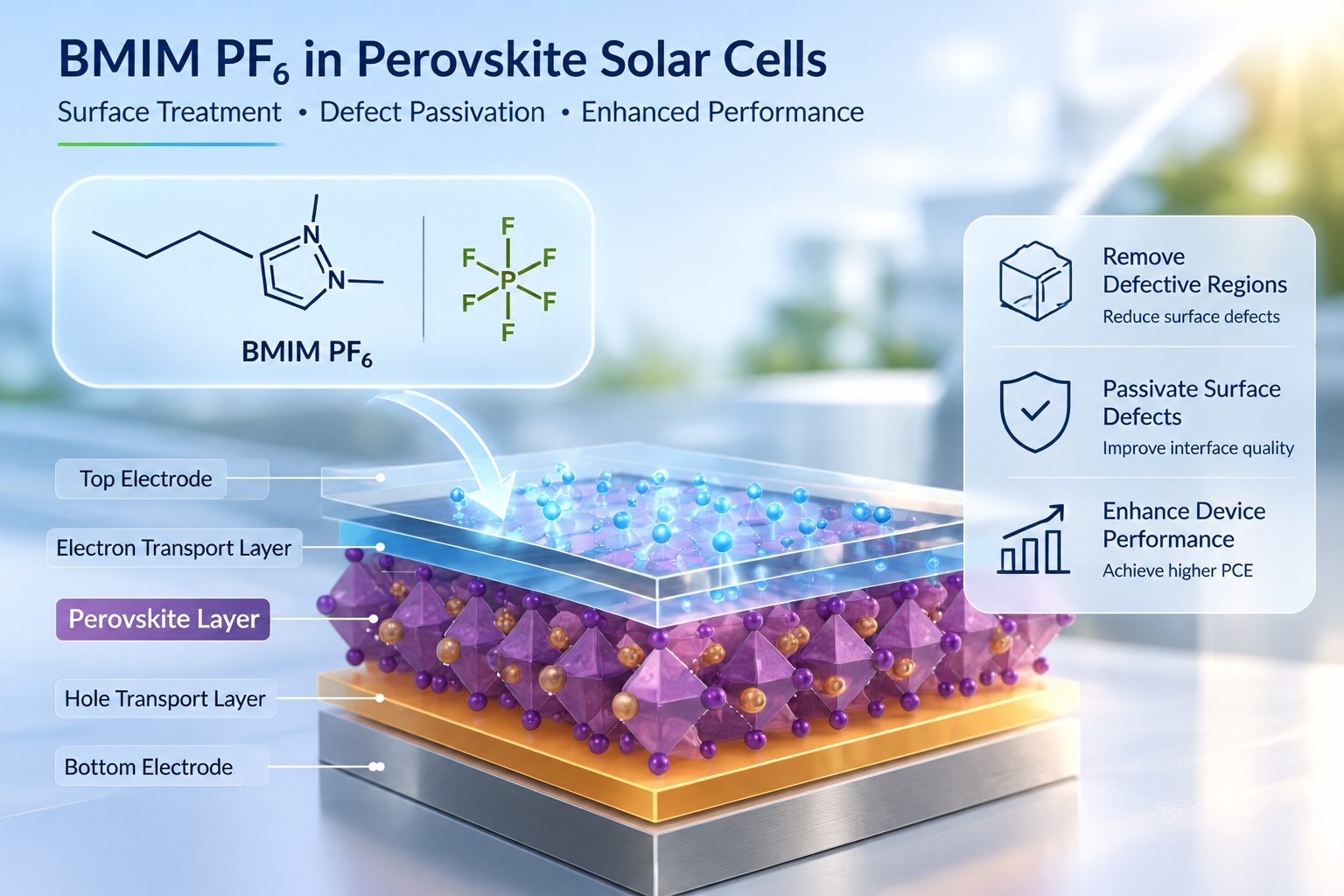
BMIM PF6 in perovskite solar cells has attracted research interest as a functional ionic liquid for surface treatment and defect management. Researchers have explored its ability to modify defective perovskite surfaces and improve the quality of the interface between the perovskite material and adjacent layers.
How Is BMIM PF6 Used in Perovskite Solar Cells?
1-Butyl-3-methylimidazolium hexafluorophosphate (BMIM PF6) is an imidazolium-based ionic liquid. In perovskite research, scientists have investigated BMIM PF6 as a surface treatment rather than simply using it as a conventional additive.
One notable approach uses BMIM PF6 to selectively remove defective regions from the surface of a perovskite film. This process can expose a more crystalline surface while allowing the ionic liquid to interact with remaining surface defects.
BMIM PF6 for Defective Perovskite Surface Treatment
A 2022 study published in Advanced Energy Materials investigated BMIM PF6 for treating CsPbI₂Br perovskite surfaces.
The researchers developed a stoichiometric dissolution strategy to remove defective regions containing nanocrystalline and amorphous phases. According to the study, BMIM PF6 could dissolve these defective regions while retaining the stoichiometry and lattice continuity of the underlying perovskite surface.
The researchers also found that ionic liquid molecules could adsorb onto the perovskite surface through Coulombic interactions and passivate undercoordinated surface lead centers. This surface modification reduced the trap density of the tested devices.
The optimized CsPbI₂Br solar cell achieved a reported power conversion efficiency (PCE) of 17.51% and an open-circuit voltage (Voc) of 1.37 V under the study’s experimental conditions.
Why Is This Research Interesting?
The study demonstrates an interesting role for BMIM PF6 in perovskite solar cell development. Instead of simply adding an ionic liquid to the perovskite precursor, researchers used BMIM PF6 as part of a surface treatment strategy.
This approach combines two functions:
- Defective surface removal: BMIM PF6 helps dissolve defective regions on the CsPbI₂Br surface.
- Surface passivation: The ionic liquid can interact with undercoordinated lead centers after the treatment.
- Lower defect-related losses: The resulting surface modification can reduce trap density in the tested device.
- Improved device performance: The optimized device reached 17.51% PCE in the reported study.
However, these results come from a specific CsPbI₂Br device system and experimental process. Researchers should not assume that the same performance will occur with other perovskite compositions or processing methods.
What Should Researchers Consider When Selecting BMIM PF6?
For researchers evaluating BMIM PF6 in perovskite solar cells, purity and impurity control are important. Water content, residual starting materials, ionic impurities, and batch-to-batch consistency can all matter when researchers work with sensitive photovoltaic materials.
In addition, researchers should evaluate the compatibility of BMIM PF6 with their specific perovskite composition, solvent system, concentration, and surface-treatment process.
BMIM PF6 from Hainan Sincere Industries
Hainan Sincere Industries Co., Ltd. supplies BMIM PF6 and a range of other ionic liquids for research and industrial applications.
We can provide product information and relevant documentation to support customer evaluation. Depending on the application and required specifications, we can discuss product purity, water content, packaging, quantity, and other technical requirements.
Looking for BMIM PF6 for perovskite solar cell research or other applications?
Contact Hainan Sincere Industries to discuss your specifications and supply requirements.