Safer Lithium Metal Batteries with Pyr13FSI-Based Electrolytes
Introduction: Solving Key Challenges in Battery Safety and Stability
Lithium metal batteries (LMBs) hold immense promise due to their high energy density, but they face significant safety concerns—chief among them, the use of flammable, unstable carbonate-based liquid electrolytes. These traditional electrolytes are prone to decomposition, dendrite formation, and fire hazards, limiting their viability for commercial applications.
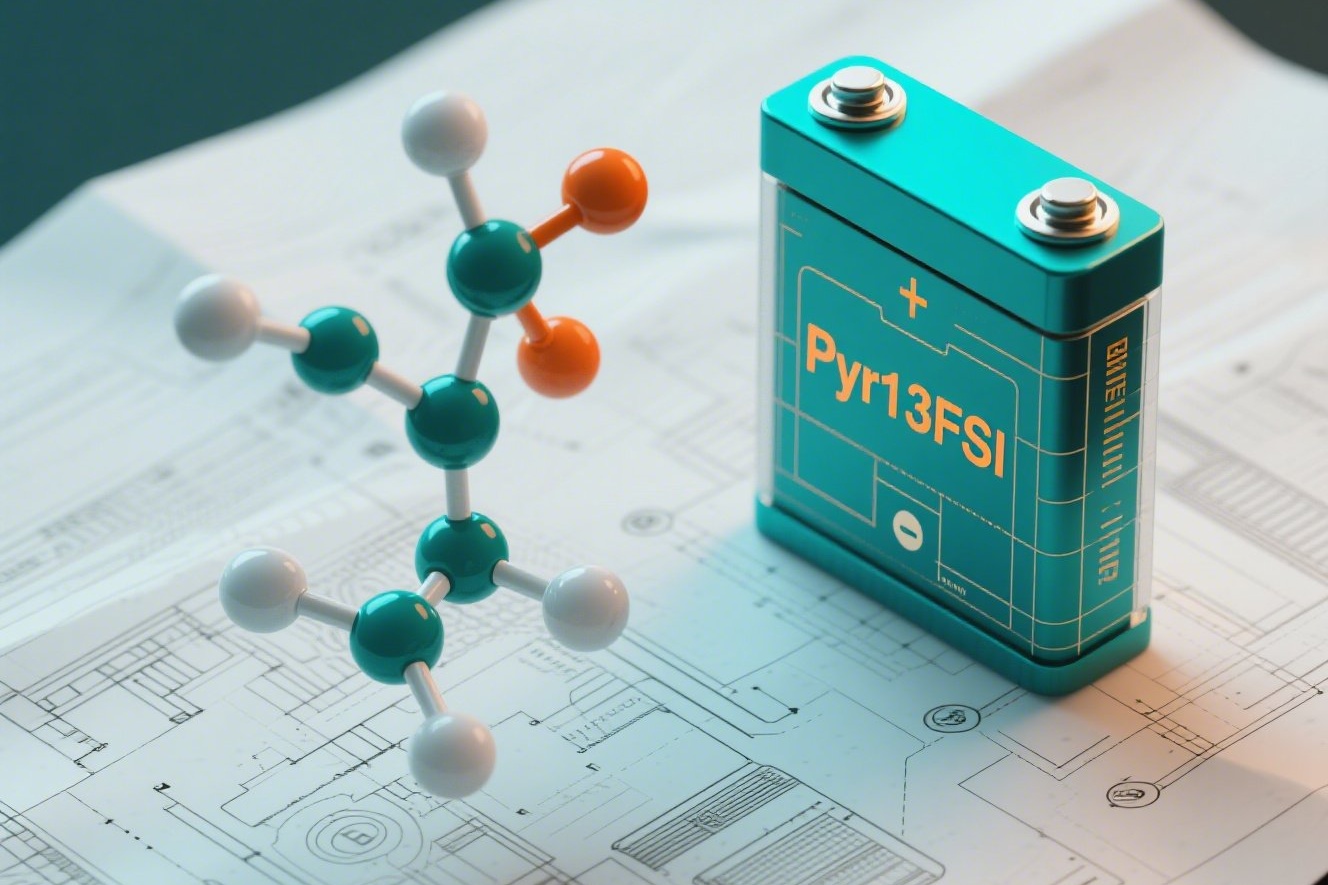
A Game-Changer: N-Propyl-N-methylpyrrolidinium Bis(fluorosulfonyl)imide (Pyr13FSI)
To address these issues, a new class of gel polymer electrolytes (GPEs) enhanced with N-Propyl-N-methylpyrrolidinium bis(fluorosulfonyl)imide (Pyr13FSI) has emerged. Pyr13FSI is a room-temperature ionic liquid (RTIL) with excellent thermal, chemical, and electrochemical properties that make it ideal for next-generation solid-state batteries.
Why Focus on Pyr13FSI?
Pyr13FSI offers several crucial benefits that make it stand out as a core component in modern GPE formulations:
- High ionic conductivity (>1 mS cm⁻¹ at 20 °C), enabling fast lithium-ion transport
- Non-flammability and low volatility, drastically improving battery safety
- Broad electrochemical stability window, compatible with lithium metal anodes
- Excellent thermal tolerance, maintaining performance from 0 °C to 90 °C
Hybrid Network Design: PEG-POSS Meets Pyr13FSI
A recent study by Professor Christopher Li at Drexel University published in Energy Storage Materials demonstrates a hybrid GPE structure combining:
- Poly(ethylene glycol) (PEG) for ion transport
- Polyhedral oligomeric silsesquioxane (POSS) for mechanical reinforcement
- Pyr13FSI + LiFSI salt for ionic conductivity and thermal stability
This network successfully integrates mechanical robustness and electrochemical functionality, addressing a common challenge in GPE development.
Performance Achievements
- Dendrite-free lithium plating/stripping even at high current densities of 1 mA cm⁻²
- Exceptional cycling stability: 6800 hours in symmetric lithium cells at 0.1 mA cm⁻²
- Enhanced thermal and mechanical properties, critical for demanding real-world applications
Commercial Outlook: Safer Batteries for All
With the integration of Pyr13FSI, LMBs can now achieve:
- Safer operation across wide temperature ranges
- Longer cycle life and higher energy efficiency
- Viability in sectors including:
- Consumer electronics
- Electric vehicles (EVs)
- Grid-level energy storage