How Ionic Liquid as Lubricant Additives Improve Friction and Wear Performance
Why Engineers Are Exploring Ionic Liquid as Lubricant Additives
As industrial equipment continues to operate under higher loads, wider temperature ranges, and longer maintenance intervals, lubricant formulators are under increasing pressure to improve both efficiency and durability.
Conventional additive technologies—including ZDDP, sulfurized additives, phosphorus compounds, and organic friction modifiers—continue to play an important role. However, modern formulations often require additional solutions capable of delivering stable performance under severe operating conditions.This has led researchers and formulation engineers to investigate ionic liquid as lubricant additives, a class of functional materials that combines molecular design flexibility with excellent tribological performance.
Rather than replacing conventional additives, ionic liquids are increasingly being evaluated as complementary components for next-generation lubricant formulations.
What Makes Ionic Liquids Different?
Unlike conventional molecular additives, ionic liquids are composed entirely of cations and anions.By selecting different ion combinations, researchers can tailor properties such as:thermal stability、lubricity、polarity、electrical conductivity、hydrophobicity、solubility、surface affinity.These tunability allows ionic liquids to be designed for specific lubricant systems rather than relying on a one-size-fits-all chemistry.
For lubricant applications, imidazolium-based ionic liquids remain among the most extensively studied due to their balance of stability, lubrication performance, and synthetic versatility.Therefore, ionic liquid as lubricant additives are now receiving increasing attention.
How Ionic Liquids Reduce Friction and Wear
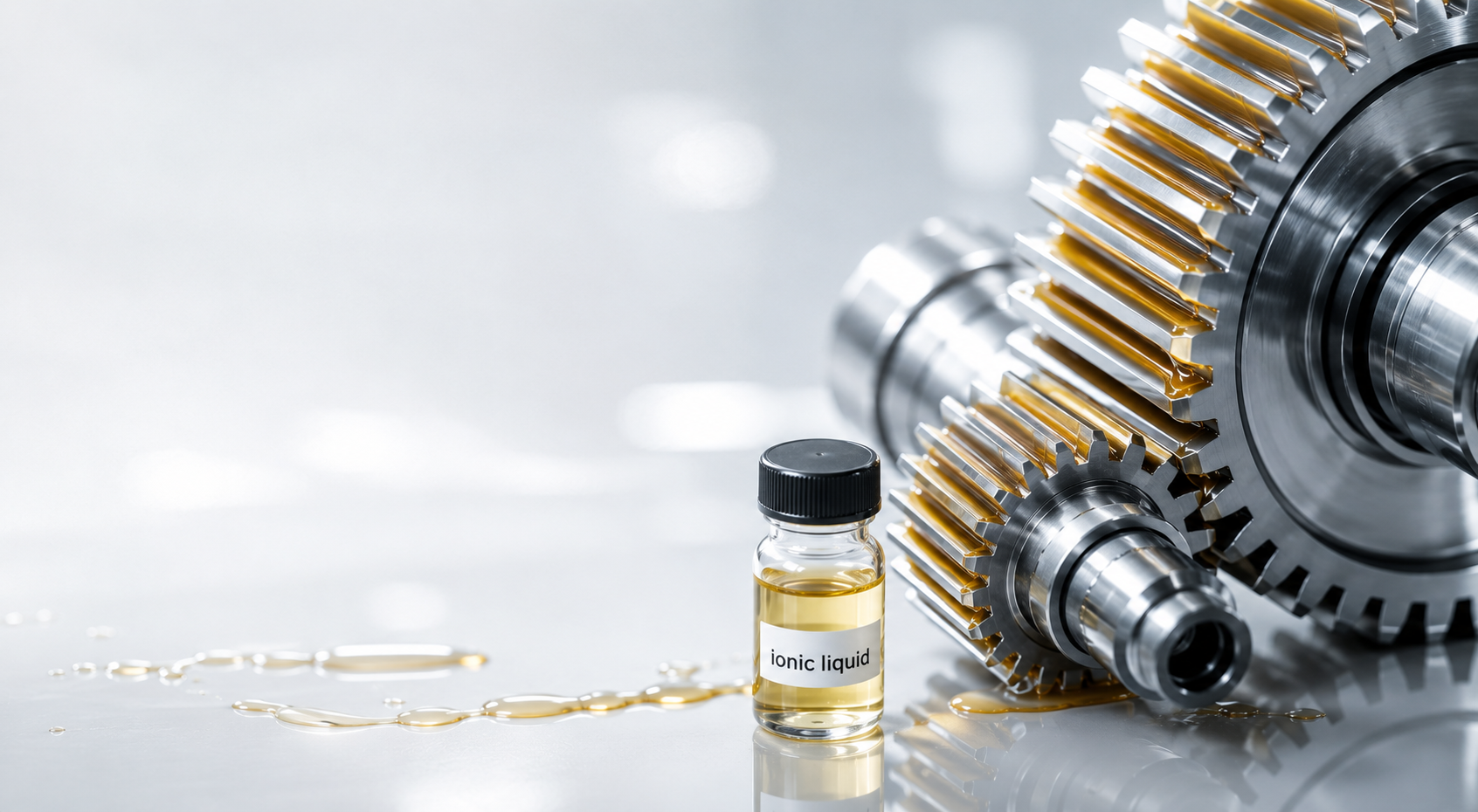
Most lubricant systems eventually enter boundary lubrication, where direct surface contact becomes unavoidable.Under these conditions, ionic liquids can adsorb strongly onto metal surfaces because of their ionic nature.
During operation, this adsorption may promote the formation of protective boundary films or tribofilms that reduce direct metal-to-metal contact.Depending on formulation and operating conditions, properly selected ionic liquids may contribute to:
- Reduced coefficient of friction
- Lower wear rates
- Improved anti-scuffing performance
- Higher load-carrying capacity
- Enhanced thermal stability of the lubricant
- Longer equipment service life
Actual performance should always be validated under the intended application conditions.
Choosing the Right Ionic Liquid for Lubricant Formulation
There is no universal ionic liquid suitable for every lubricant.
Selection depends on the base oil, operating environment, target viscosity, materials being lubricated, and desired performance.
Below are several imidazolium ionic liquids commonly evaluated by formulation engineers.
| Ionic Liquid | Typical Characteristics | Potential Uses |
|---|---|---|
| BMIM PF₆ | Hydrophobic, excellent thermal stability, good anti-wear behavior | Industrial lubricants, metalworking fluids |
| OMIM PF₆ | Longer alkyl chain with stronger surface adsorption | Heavy-duty lubrication, boundary lubrication |
| OMIM BF₄ | Balanced polarity and lubrication performance | Specialty lubricant formulations |
Different anion systems—including PF₆⁻, BF₄⁻, TFSI⁻, FSI⁻, DCA⁻, acetate, lactate, chloride, and bromide—may significantly influence viscosity, hydrolytic stability, conductivity, corrosion behavior, and compatibility with various lubricant systems.
Selecting the appropriate cation–anion combination is therefore one of the most important steps during formulation development.
Key Factors Before Selecting an Ionic Liquid Supplier
For many lubricant developers, selecting an ionic liquid is only the first step.Successful scale-up also depends on the supplier’s ability to provide consistent product quality.Before moving from laboratory evaluation to pilot production, engineers often assess:
- Batch-to-batch consistency
- Product purity
- Moisture control
- Metal impurity levels
- Technical documentation (COA, SDS, TDS)
- Long-term supply capability
- Availability of customized ionic liquid structures
These factors become increasingly important as formulations move closer to commercialization.
Beyond Standard Products: Custom Ionic Liquid Development
Many lubricant companies do not purchase ionic liquids as finished commercial products.
Instead, they evaluate multiple ionic liquid structures before selecting the chemistry that best fits their formulation.
As research progresses, requirements may evolve from standard catalog products to customized ionic liquid systems with specific combinations of:
- Cation structures
- Functional anions
- Purity specifications
- Water content limits
- Application-specific properties
A supplier capable of supporting this transition can help shorten development cycles and improve formulation efficiency.
Our Ionic Liquid Portfolio
Hainan Sincere Industries supplies a broad range of ionic liquids for research, formulation development, and industrial applications.
Our portfolio includes multiple cation families together with diverse anion systems, including:
- PF₆⁻
- BF₄⁻
- TFSI⁻
- FSI⁻
- DCA⁻
- OTf⁻
- Acetate
- Lactate
- Chloride
- Bromide
Besides standard catalog products, we also support customized specifications based on application requirements, including purity, moisture limits, packaging, and technical documentation.
FAQs
Are ionic liquids suitable for all lubricant formulations?
Not necessarily. Compatibility with the base oil, additive package, and operating environment should always be evaluated through laboratory testing.
Which ionic liquids are commonly used in lubricant research?
Imidazolium-based ionic liquids containing PF₆⁻, BF₄⁻, TFSI⁻, FSI⁻, and DCA⁻ anions are among the most frequently reported in tribology research.
Can ionic liquids be customized?
Yes. Many industrial projects require tailored ionic liquid structures or specific quality specifications rather than standard commercial grades.
What information is helpful before requesting a quotation?
Providing the intended application, target performance, annual demand, required purity, destination country, and any special technical requirements allows suppliers to recommend the most suitable ionic liquid and prepare an accurate quotation.
Looking for an Ionic Liquid Supplier?
Whether you are screening ionic liquids for lubricant research, developing a new friction modifier, or evaluating materials for pilot-scale production, selecting the right chemistry is only part of the process.
Equally important are reliable manufacturing, consistent quality, technical support, and the ability to provide customized ionic liquid solutions as your project progresses.
If you are evaluating BMIM PF₆, OMIM PF₆, OMIM BF₄, or other ionic liquid systems for lubricant applications, feel free to contact our technical team. We are happy to discuss your formulation goals and recommend suitable ionic liquid options for laboratory evaluation and future scale-up.