
what is succinic acid?
Succinic acid scientific name butanedioic acid. is a dicarboxylic acid. It was named after the German scientist Gerogius Agrieola in 1546 for separating it from amber. The molecular formula is C₄H₆O₄, the relative molecular weight is 118.09, it is a colorless or white triclinic crystal or monoclinic crystal, the melting point is 188℃, it can be dissolved in water, ethanol, ether and other solvents, it is a common natural organic acid, it can be produced by the tricarboxylic acid cycle pathway or the pyruvate carboxylation branch, and it is widely present in the human body, animals, plants and microorganisms.
It exists naturally in various plants and animals and is an important intermediate in the citric acid cycle (Krebs cycle), a key metabolic pathway for producing energy in cells. It is an active organic compound that participates in all metabolic processes of organisms (including carbohydrate metabolism, protein metabolism, and fat metabolism) and is present in various organs at the same time.
Succinic acid is a product of amber distillation and was first synthesized in the 17th century. It exists in its original form in plant and animal tissues or in various forms of esters in nature. With the rapid advancement of fermentation technology and processes, the global succinic acid market has gained strong growth momentum. It is widely used in the chemical, pharmaceutical, food and other industries, and with the continuous development of application fields, the market demand is increasing year by year. The U.S. Department of Energy compared the technical feasibility and market potential of 300 compounds. Then it announced 12 compounds with the potential for mass production in August 2004, among which succinic acid ranked first.
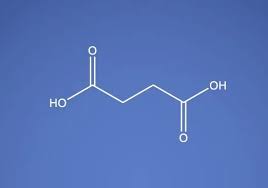
| Molecular formula: | C4H6O4 |
| CAS number: | 110-15-6 |
| Molecular weight: | 118.09 |
| Solubility in water: | 58 g/L |
| Boiling point: | 235℃ |
| Melting point: | 184 to 186℃ |
| Appearance: | White odorless hygroscopic crystals, soluble in water, ethanol and acetone, slightly soluble in some organic solvents, used to prepare resins, plastics, plasticizers, lubricant additives, etc. |
| Packaging | 25 kg /bag |
Production methods
The production methods of succinic acid mainly include chemical synthesis and biological fermentation.
- Chemical synthesis consumes a lot of petrochemical raw materials and electricity, and will also cause serious environmental pollution.
- Biological fermentation is to use microorganisms to ferment renewable biomass energy, which has a long cycle and less environmental pollution.
Application
Succinic acid is a typical dibasic acid, and it contains two active methylene groups with many reaction characteristics such as halogenation, dehydration, esterification, sulfonation, acylation, oxidation, reduction, etc., which can prepare rich succinic acid derivatives. This makes succinic acid an important organic chemical raw material and intermediate. The main application areas of succinic acid can be roughly divided into:
- Surfactants, detergents, additives and foaming agents;
- Ion chelating agents, anti-corrosion such as dissolution and pitting in the electroplating industry;
- In the food industry as acidifiers, pH modifiers, antibacterial agents, enhancers and emulsifiers;
- Health-related products, including the production of medicines, antibiotics, amino acids and vitamins;
- A newly developed application in recent years, which has a good development prospect and is the main raw material for biodegradable plastic polybutylene succinate (PBS). PBS itself has excellent mechanical properties, reasonable price, and great market demand. Currently, Germany’s BASF, Japan’s Mitsubishi, China’s Tsinghua University, and the Institute of Physics and Chemistry of the Chinese Academy of Sciences have successfully developed and mass-produced it. According to expert analysis, the market growth space for succinic acid is enormous.
We will introduce the following applications in detail:
1. Food and beverage:
- Succinic acid (including salts) can produce sourness and flavor, and can be used in soybean paste, soy sauce, Japanese sake, seasonings, etc. Sodium succinate is a white crystalline powder with a special taste of shellfish. Food flavoring (can also be used as a food acidifier for flavoring wine, feed, candy, etc.).
- In the food industry, it is used as a flavoring agent, acidifier, buffer, and is used for ham, sausage, aquatic products, seasoning liquid, etc.
- Used as a preservative, pH regulator, and cosolvent;
2. Industrial chemicals
- As an ion chelating agent, succinic acid is used in the electroplating industry to prevent metal dissolution and pitting;
- A good surfactant and a component of detergents, soaps, and demulsifiers;
- Produce depilatories, toothpastes, cleaning agents, and high-efficiency wrinkle-removing beauty esters.
- In lubricants, additives, and elastomers. In textile processing, it can be used for sizing to prevent shrinkage and improve dyeability.
- Improve the viscosity and fire resistance of caprolactam, etc.
- Mainly used to prepare pentacyclic compounds such as succinic anhydride.
- It is also used to prepare alkyd resins (alkyd resins produced from succinic acid have good flexibility, elasticity and water resistance.), paints, dyes (diphenyl esters of succinic acid are intermediates of dyes, and react with aminoanthraquinone to form anthraquinone dyes.), photographic materials, etc.
3. Pharmaceuticals
- In the pharmaceutical industry, it can be used to produce sulfonamides, vitamin A, vitamin B and other antispasmodics, expectorants, diuretics and hemostatic drugs. As a chemical reagent, it is used as a standard reagent for alkaline titration, a buffer, and a gas chromatography comparison sample. It can also be used as a raw material for lubricants and surfactants.
- Application in cosmetics and medical beauty and skin repair effects:
- as an effective and widely used ingredient, can solve many skin problems and is widely used in the beauty field.
- As a safe ingredient, can be used for any type of skin care, including sensitive skin and mature skin. Succinic acid can quickly and accurately repair the skin without affecting the healthy epidermis. This feature of succinic acid is suitable for treating acne or reducing age spots.
- Succinic acid, like other acids such as lactic acid, has a certain exfoliating effect: it can reduce skin pigmentation, alleviate signs of aging, freckles and acne, make the skin texture more even and improve the skin tone. After use, the skin will become clean, smooth and radiant again. Based on this, it is often used in exfoliating acid cosmetics and toners.
4.Used as a raw material for organic synthesis.
It has been recognized as GRAS (generally regarded as safe) by the US FDA, which allows it to be used for a variety of purposes. It is an intermediate product of the tricarboxylic acid cycle (TCA) and is also one of the fermentation products of anaerobic metabolism. Succinic acid is widely used in medicine, pesticides, dyes, fragrances, paints, food, plastics and other industries. It can also be used as a C4 platform compound to synthesize some important chemical products such as butanediol, tetrahydrofuran, γ-butyrolactone, n-methylpyrrolidone (NMD), 2-pyrrolidone, etc. The global market demand exceeds 276,000 t/a. In addition, succinic acid can also be used to synthesize degradable biopolymers such as polybutylene succinate (PBS) and polyamide, which makes the market demand for succinic acid as high as 27,000,000 t/a.
5. Others
Other major applications of succinic acid include detergents, pigments, toners, photographic chemicals, alkyd resins, plasticizers, cement additives, flux, metal treatment chemicals and coatings.
Market
Currently, the sales volume of industrial-grade succinic acid exceeds 15,000 tons, which is generally produced from butane through maleic anhydride through petrochemical methods. Only succinic acid for the food market is produced by fermentation. The new fermentation process can reduce the sales price of succinic acid to $2.20/kg (5,000 tons per year); when the annual production is 75,000 tons, its sales price will be less than $0.55/kg, which can open up new commercial chemical markets for succinic acid. The U.S. Department of Energy has invested $7 million in industrial research on the fermentation production of succinic acid.
There are four main markets for succinic acid: the largest market is as a surfactant, detergent additive and foaming agent; the second market is as an ion chelating agent, used to prevent metal dissolution and pitting in the electroplating industry; the third market is in the food industry as an acidifier, pH modifier, flavoring agent and antibacterial agent; the fourth market is health-related products, including the production of medicines, antibiotics, amino acids and vitamins. The total amount of these four markets for succinic acid exceeds $400 million per year.
The succinic acid market is driven by the huge growth potential of converting succinic acid into a series of industrial chemicals with strong demand dynamics. However, the production process of bio-based succinic acid is complex and expensive. The choice of inputs along with a good understanding of the purification process remain crucial for the sustainable production of succinic acid.
The major players in the global succinic acid market are enhancing their manufacturing capabilities as evident from the capacity expansions of Succinity, Myriant, and Reverdia. The availability of microorganisms as a reliable source of succinic acid is expected to provide a major impetus to the bio-based succinic acid market. Value-added and derivative products of succinic acid provide another lucrative platform for businesses. The fact that succinic acid serves as a precursor for many industrial chemicals and consumer products further boosts the overall market growth.
The overall market sentiment for succinic acid is also boosted by strong production and subsequent demand for polyurethanes, resins, and plasticizers. Succinic acid is also generally recognized as safe by the U.S. Food and Drug Administration. It is increasingly used as a flavoring base, acidity regulator in various food products. Food manufacturers and processors across the globe have recognized succinic acid as a versatile, clean label flavor enhancer. It is also being included in low-sodium diets due to its flavor-extending properties.
Key Players Covered
The major companies in the global succinic acid market include Nippon Shokubai Co. Ltd, Succinity GmbH, Global Chemical Public Company Limited, Mitsubishi Chemical Holdings Group, Novomer Inc., BASF SE, Kawasaki Kasei Chemicals Ltd., Roquette Frères, and ESIM Chemicals GmbH.
The global succinic acid market presents a notable presence of major giants that have leveraged their strengths with advanced succinic acid manufacturing technologies, stringent quality control procedures, strong reliability factors, and a well-established supplier and customer base. Hence, the threat of new entrants in the global succinic acid market is high
Key Market Locations:
- North America (United States, Canada and Mexico)
- Europe (France, Germany, Italy, Spain, United Kingdom, Russia and Rest of Europe)
- Asia Pacific (China, India, Japan, Australia and Rest of Asia Pacific)
- South America (Brazil, Argentina and Rest of South America)
- Middle East and Africa (South Africa, UAE and Rest of Middle East and Africa)
Regional Analysis
The Asia Pacific succinic acid market is expected to be the fastest growing region during the forecast years (2019-2026) due to strong encouragement of manufacturing, availability of labor and growing interest of Western companies in tapping the potential of countries like China and India. The cost competitiveness of succinic acid makes it an ideal alternative to conventionally produced chemicals.
The succinic acid market in the United States and Europe is also showing a good growth trajectory – the U.S. Department of Energy has also listed succinic acid (SA) as one of the most promising bio-based building blocks for the future due to its versatility and wide range of applications. Western developed markets are expected to witness high-value niche applications
Key Industry Developments
In April 2019, Royal DSM and Roquette dissolved their joint venture Reverdia, with the rights and obligations relating to Reverdia’s Biosuccinium plant in Cassano, Italy, being transferred to Roquette.